Clarify requirements
Translate the customer’s need into defined requirements, responsibilities and acceptance criteria.



Quality approach
SEM Aérospatiale has initiated a certification process based on ISO 9001, EN 9100 and EN 9110. This process is ongoing: the certifications are targeted and have not yet been obtained.
The aim is to align engineering, manufacturing, maintenance and inspection around shared methods, documented information and measurable improvement actions.

Why this approach?
The approach is designed to make requirements clearer, strengthen traceability and control the interfaces between design, production, maintenance and delivery.
Translate the customer’s need into defined requirements, responsibilities and acceptance criteria.
Identify sensitive points, prevent FOD and reduce the risk of non-conformity or rework.
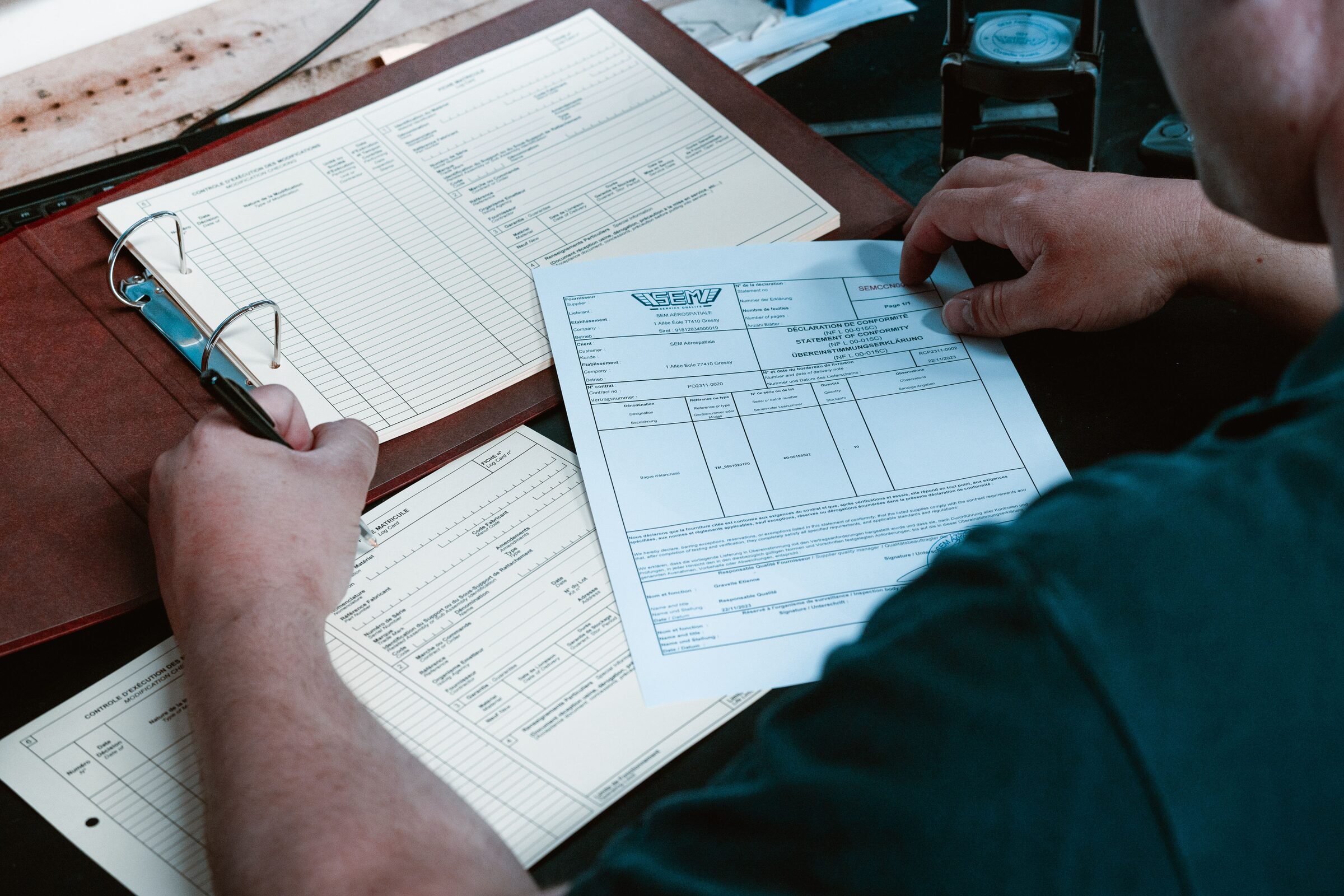
Keep the information needed to understand, control and trace the work performed.
Give the team common reference points and capitalise on technical knowledge over time.
Targeted certifications
Each framework supports a specific level of the quality management system. Certification audits will have to confirm conformity before any certification can be claimed.
A general framework for managing processes, customer focus, documented information and continuous improvement.
Certification targeted · process ongoingAerospace-sector requirements that supplement quality management with greater attention to product conformity, risks and traceability.
Certification targeted · process ongoingRequirements intended for aviation maintenance organisations and the control of maintenance activities.
Certification targeted · process ongoingHow it works
The management system is built progressively: define what must be done, apply it, verify the results and improve what needs to be improved.
Map processes, responsibilities, requirements and the records to be retained.
Use the agreed methods and ensure the traceability appropriate to each operation.
Review results, indicators, deviations and the effectiveness of the controls in place.
Analyse causes, plan actions and verify that the actions taken are effective.
Practical benefits
More consistent execution, clearer follow-up and evidence tailored to the work performed.
Better-controlled interfaces from the initial requirement through manufacturing, inspection or maintenance.
Shared methods, clearer responsibilities and more effective transfer of technical knowledge.
A structured framework for learning from deviations and making improvements last.
Our quality policy
Our policy sets a shared direction for the gradual construction of the quality management system and preparation for the targeted certifications.
Clarify intended use, technical requirements and acceptance criteria before committing.
Carry out and check each operation against the applicable requirements.
Retain useful, readable and controlled information throughout the project.
Protect products, organise work areas and address sensitive points as early as possible.
Share methods, capitalise on experience and maintain the knowledge needed for our work.
Use feedback and deviations to define relevant and sustainable actions.
ISO 9001, EN 9100 and EN 9110 certifications are currently being pursued.